 Sleepeek
Sleep talking is common
The medical term is somniloquy: talking during sleep, from a simple mumble to whole sentences. Inserm, France’s national health research institute, lists it among the parasomnias, behaviors that happen during sleep (Inserm, in French).
A research review describes it as one of the most common night-time behaviors in the whole population (Alfonsi et al., 2019). The numbers back this up: in a telephone survey of 1,000 adults in Norway, 66.8% said they had talked in their sleep at some point, and 17.7% had done so at least once in the past three months (Bjorvatn et al., 2010). The authors say these figures should be read with caution: few people answered, and each disorder was covered by a single question.
If someone heard you talking last night, you’re in the majority.
Why it happens
A night moves through several kinds of sleep: non-REM sleep, light and then deep, and REM sleep, the dreaming stage, when the muscles are relaxed (Inserm, in French). Sleep talking can happen in both: a study at the Pitié-Salpêtrière hospital in Paris recorded talking during non-REM sleep as well as REM sleep (Arnulf et al., 2017). So you don’t only talk when you’re dreaming.
For parasomnias in general, Inserm lists factors that make them more likely: stress, fever, certain medications and some neurodegenerative diseases (Inserm, in French).
What people actually say
The Pitié-Salpêtrière study analyzed 883 episodes of talking recorded in the sleep lab, from 232 people (Arnulf et al., 2017):
- most episodes aren’t words: 59% are mumbles, shouts, whispers or laughs;
- the most frequent word is “no”: negations make up 21.4% of clauses;
- swear words aren’t rare: 9.7% of clauses contain one;
- the grammar is that of a real conversation, often a tense one, with someone you can’t hear.
One caveat: most people in this study had a sleep disorder (sleepwalking, night terrors, REM sleep behavior disorder); only 15 were healthy. The words of someone who sleeps well don’t necessarily have the same tone.
Is it serious?
On its own, no. The international classification of sleep disorders (ICSD-3) lists sleep talking among “isolated symptoms and normal variants,” alongside the jerks you feel as you fall asleep (Meurling et al., 2022). The 2019 review says so too: sleep talking isn’t a disease (Alfonsi et al., 2019).
It can still be a nuisance, especially for the person sleeping next to you. What matters is what comes with the talking. Talking with no other sign falls under this normal variant. Shouting while thrashing about is something else: the next section says what to watch for.
When to see a doctor
The MSD Manuals describe sleep disorders where talking comes with other signs (MSD Manual). Talk to your doctor if:
- you shout, swear or thrash about in your sleep, as if acting out your dream: this is the sign of REM sleep behavior disorder, more common in older adults and sometimes linked to a neurological disease;
- you’ve hurt yourself in your sleep, or hurt the person who sleeps with you;
- you’re seen sitting up, screaming and flailing about, frightened, eyes wide open: these are night terrors; in adults, they are often linked to psychological problems or to alcohol use;
- you’re tired or sleepy during the day even though you get enough sleep.
What the person who shares your room describes helps the doctor make the diagnosis. If in doubt, the doctor may suggest a sleep study (polysomnography).
Hearing yourself talk
You don’t remember what you say at night. To hear it, there are two ways: ask the person who sleeps next to you, or record yourself. The guide on how to record yourself sleeping explains where to put the phone and how many nights to plan.
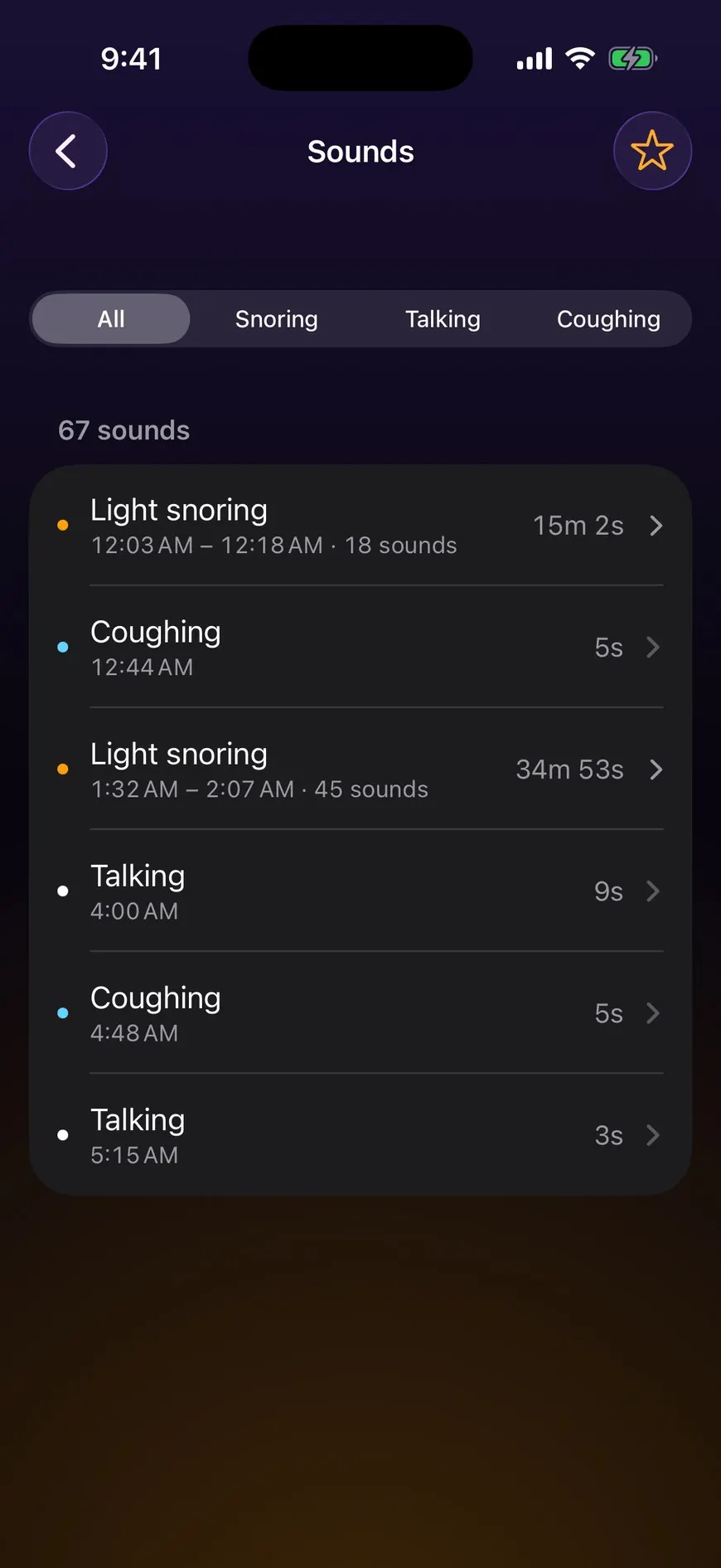
An app that starts when it hears a sound only keeps the moments when something happens, and sorts them by type: snoring, talking, coughing. A very short mumble can end up in “other” rather than “talking”: the app sorts sounds in slices of a few seconds, and a shorter sound does not always stand out. The guide on how an app that records sounds at night works explains this sorting. With Sleepeek, in the morning, you filter the sounds on “Talking” and listen back to each clip at its time; also listen to the “other” sounds around it.
Record yourself for several nights: you might talk a lot one night and not at all the next. If you need to see a doctor, these clips let them hear what happens.
Frequently asked questions
Do you remember talking in your sleep?
Usually not. Researchers describe sleep talking as sounds and words produced without being aware of it. That's why you almost always find out from someone else, or from a recording.
Do you only talk when you're dreaming?
No. Dreams are mostly linked to REM sleep, but talking has been recorded during REM sleep as well as non-REM sleep. So you can talk at different times of the night.
How can I tell if I talk in my sleep?
Ask the person who sleeps next to you. If you sleep alone, record yourself for one or more nights with an app that starts when it hears a sound, and listen in the morning to the clips sorted as talking.
What do you say at night? Record yourself tonight and listen back to your sleep talk when you wake up.
Sources
- Inserm, « Sommeil » (feature), updated November 8, 2024 (in French), accessed November 3, 2026.
- Bjorvatn B., Grønli J., Pallesen S., “Prevalence of different parasomnias in the general population”, Sleep Medicine, 2010 (PubMed), accessed November 3, 2026.
- Arnulf I. et al., “What Does the Sleeping Brain Say? Syntax and Semantics of Sleep Talking in Healthy Subjects and in Parasomnia Patients”, Sleep, 2017 (PubMed), accessed November 3, 2026.
- Alfonsi V. et al., “Sleep talking: A viable access to mental processes during sleep”, Sleep Medicine Reviews, 2019 (PubMed), accessed November 3, 2026.
- Meurling I. J., Leschziner G., Drakatos P., “What respiratory physicians should know about parasomnias”, Breathe, 2022 (PMC), accessed November 3, 2026.
- MSD Manual Consumer Version, “Parasomnias”, last updated August 2026, accessed November 3, 2026.
Written by The Sleepeek team. How we write and check our guides.
Read next
- How to record yourself sleeping: a step-by-step guideA sleep recording app and a phone plugged in by the bed are all you need. The settings, the mistakes to avoid and what you'll hear in the morning.
- App that records sounds at night: how it worksAn app that records sounds at night only keeps the sounds louder than your quiet room. How it sorts them, sensitivity, and the sounds that fool it.