 Sleepeek
Why people snore
Snoring comes from the throat. During sleep, the muscles at the back of the throat, the soft palate, the uvula and the tongue relax. They take up more room and narrow the airway; as you breathe in, the air makes the pharynx vibrate, and that’s the sound you hear (ameli.fr, in French).
The MSD Manual adds a simple image: relaxed tissue flutters more easily, just as a cloth flag flutters in a breeze where a metal sheet of the same size doesn’t move. People don’t snore while awake, which suggests that the relaxation of sleep is part of the cause (MSD).
Most of the causes below act on one of these two things: they relax the throat further, or they narrow the airway.
The common causes
| Cause | What happens | Can you change it? |
|---|---|---|
| Alcohol | a very common cause; along with smoking, it keeps up an inflammation that gets in the way of the air | yes |
| Sleeping pills, tranquilizers, some antihistamines taken at bedtime | they reduce the tone of the throat muscles | talk to your doctor |
| Sleeping on your back | lying on your back encourages snoring | yes |
| Excess weight, especially fat around the neck and belly | it encourages snoring every night | partly |
| Smoking | it causes long-lasting inflammation of the nose and throat | yes |
| Blocked nose (cold, allergy, polyps) | the lining swells and gets in the way of the air | sometimes |
| Small or receding jaw, large tongue, thick soft palate, deviated nasal septum, large tonsils | they get in the way of the air | no |
| Age (over 50), being male, menopause, pregnancy | snoring becomes more common | no |
Sources: ameli.fr, in French, ameli.fr, in French, MSD Manual, checked on November 5, 2026.
A few useful details:
- Alcohol: France’s national health insurance advises not drinking in the hours before bed, and in particular cutting out alcohol at dinner (ameli.fr, in French).
- The medicines involved are the ones taken at bedtime: sleeping pills, tranquilizers, some antihistamines. They reduce the tone of the throat muscles during the night (ameli.fr, in French). Don’t stop a treatment on your own: talk to your doctor or pharmacist.
- A blocked nose is often a temporary cause: during a cold or an allergy flare-up, the lining of the nose and throat swells and blocks the way (ameli.fr, in French).
- Anatomy doesn’t change with habits. It can explain snoring that goes on without alcohol, without excess weight and on your side.
Several causes can add up: a slightly narrow throat, a glass of wine at dinner, a night on your back.
In men, in women
Men snore more than women, and snoring increases with age: it regularly affects more than 40% of adults over 50 (ameli.fr, in French). In women, it becomes more common after menopause (ameli.fr, in French), and pregnancy is also one of the risk factors (MSD).
Finding your cause: compare your nights
Lists of causes say what makes people snore in general. To know what makes you snore, you have to watch it over several nights. France’s national health insurance suggests just that: put a few changes in habits into practice and judge the benefit for yourself (ameli.fr, in French).
- Record yourself for two weeks, without changing anything. Phone plugged in on the bedside table, an app that starts when it hears a sound: the guide to recording yourself sleeping gives the settings. If you don’t know yet whether you snore, start there: how to tell if you snore.
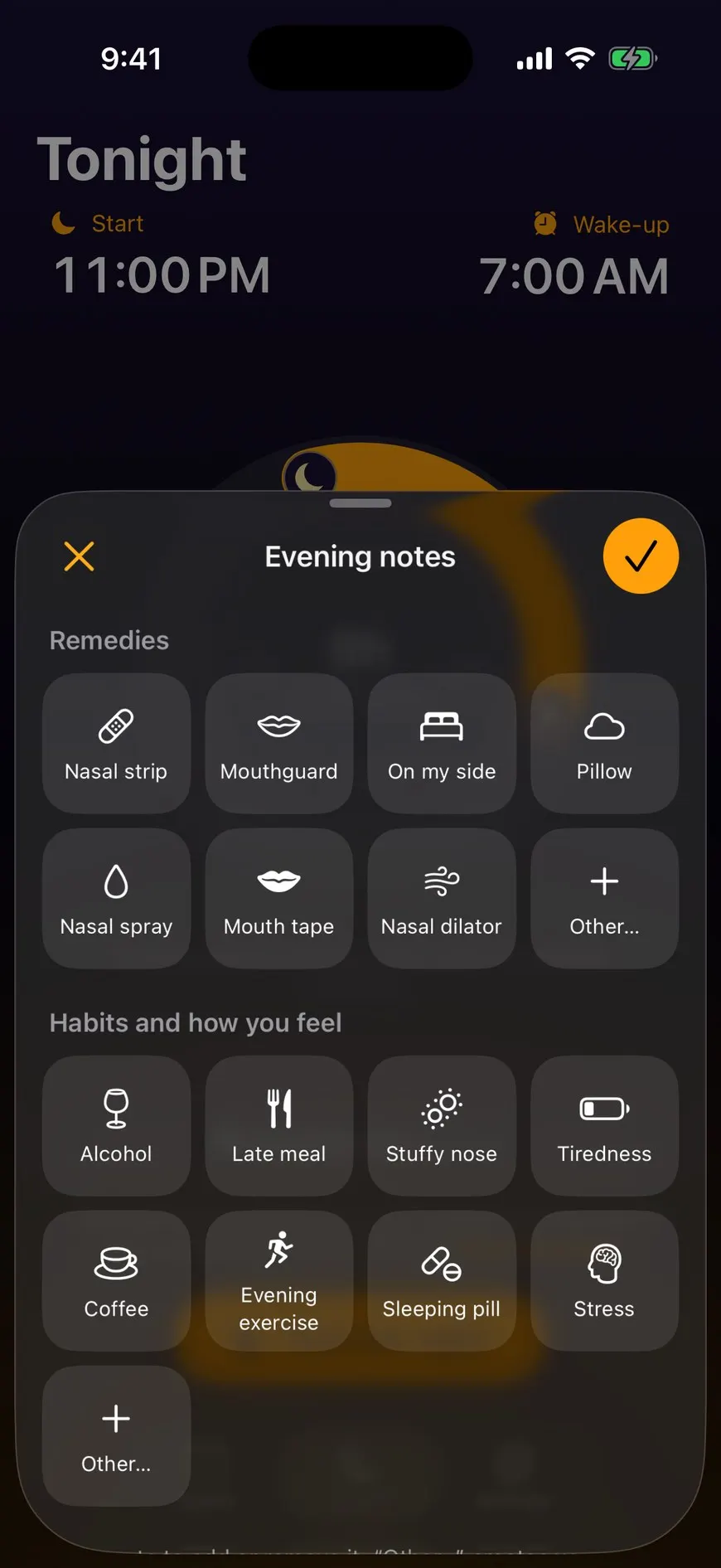
- Every evening, note whatever is out of the ordinary: a drink or more, a late meal, a stuffy nose, being very tired, a sleeping pill.
- Every morning, look at how long you snored, and listen to a few clips to check that it really is you, and really snoring (why sound sorting sometimes gets it wrong).
- Compare the nights with and without each thing you noted. If your nights “with a drink” have clearly more snoring than the others, you have a lead. If nothing changes, the cause is probably elsewhere.
- For position, run the test the other way: a few nights trying to stay on your side, then compare.
Keep the limits of the method in mind. One night proves nothing, because snoring varies from night to night (MSD). And if nothing you note makes a difference, your snoring may come down to your anatomy: that’s a question for a doctor.
With Sleepeek, you tick your evening notes in a few seconds (alcohol, late meal, stuffy nose, tiredness, on my side…), and in the morning you see your minutes of snoring. With Sleepeek+, the “Compare” screen puts your nights with and without each note side by side.
When to see a doctor
France’s national health insurance advises seeing a doctor in these situations (ameli.fr, in French):
- your snoring doesn’t go away despite your efforts;
- you have episodes of gasping for breath during sleep, or wake up with a start feeling like you’re choking;
- you don’t feel rested when you wake up, and you struggle to stay awake during the day;
- you doze off during the day, in front of the TV, in a meeting or at the wheel;
- your snoring comes with headaches, memory or concentration problems, irritability;
- your snoring causes tension with the person who shares your room.
The MSD Manual also lists pauses in breathing noticed by a bed partner, headaches on waking and very loud, constant snoring (MSD). Talk to your doctor: if they suspect sleep apnea, they can prescribe a medical sleep recording.
Frequently asked questions
Does snoring run in families?
Often, yes: according to the MSD Manual, snoring frequently occurs in families.
Why do I snore some nights and not others?
Snoring can be occasional, intermittent or regular, and it varies from one night to the next. Several of its causes are temporary: a cold, alcohol in the evening, a night on your back. Recording yourself shows which ones matter for you.
Does snoring always mean sleep apnea?
No. Not everyone who snores has sleep apnea, but most people who have it snore. What should raise concern: pauses in breathing, daytime sleepiness, very loud, constant snoring.
Note your evenings, compare your nights: you'll see what makes you snore.
Sources
- Assurance Maladie (ameli.fr), « Comprendre le ronflement et ses causes », July 1, 2026 (in French), accessed November 5, 2026.
- Assurance Maladie (ameli.fr), « Ronflement de l'adulte et de l'enfant : que faire ? », July 1, 2026 (in French), accessed November 5, 2026.
- MSD Manual Consumer Version, “Snoring”, last updated July 2026, accessed November 5, 2026.
Written by The Sleepeek team. How we write and check our guides.
Read next
- How to tell if you snore at night, even if you sleep aloneTo find out if you snore, ask whoever sleeps near you or record yourself. The questions that matter, how to read the result, and when to see a doctor.
- How to record yourself sleeping: a step-by-step guideA sleep recording app and a phone plugged in by the bed are all you need. The settings, the mistakes to avoid and what you'll hear in the morning.