 Sleepeek
Why you don’t know
Snoring is mostly heard from the outside. The MSD Manual puts it simply: snorers seldom know that they snore unless others tell them, though some hear their own snoring as they wake up (MSD). France’s national health insurance notes that snoring often bothers the snorer very little (ameli.fr, in French).
Wondering about it is nothing unusual: regular snoring affects more than 40% of adults over 50. Men snore more than women, and snoring increases with age and becomes more common after menopause (ameli.fr, in French).
Clues you can notice on your own
Some situations make snoring more likely. France’s national health insurance lists excess weight, alcohol and smoking, lying down, a blocked nose (a cold, an allergy) and some medicines taken at bedtime, such as sleeping pills or tranquilizers (ameli.fr, in French). If that sounds like you, it’s a reason to check, not proof. To understand each one: the causes of snoring.
Other signs may come with snoring, depending on its cause: waking up often, gasping or choking during sleep, daytime sleepiness, morning headaches (MSD).
Not having these signs doesn’t mean you don’t snore. Simple snoring, which doctors call “primary snoring”, doesn’t wake you up more often than normal and doesn’t make you sleepy during the day (MSD). So you can snore every night and feel perfectly fine.
Ask someone who has heard you
If someone sleeps near you, even for a single night (on vacation, at friends’ place), ask them. To make the answer useful, ask the questions a doctor asks a snorer’s partner (MSD):
- How many nights? Every night, or only some?
- How much of the night? All night, or for a while?
- How loud? Heavy breathing, or loud enough to keep them awake?
- Did you notice my breathing stop, or moments when I seemed to choke?
An answer like this has its limits. What counts as snoring depends on the person listening, and snoring varies from night to night (MSD). And the person sleeping next to you only hears you while they’re awake.
The simplest test: record yourself
When you sleep alone, or to check what you’ve been told, record yourself. You need your phone, plugged in, on your nightstand about 50 cm (20 inches) from your head, and an app that starts when it hears a sound: it only keeps the moments when something happens, instead of eight hours of silence. The guide to recording yourself sleeping covers the settings.
Do it for several nights. One quiet night proves nothing: snoring changes from one night to the next.
Reading the result
Ask your recording the same questions you’d ask the person who heard you:
- How many nights? Note on how many of the recorded nights there is snoring.
- How long? Look at the total snoring time in the night, and at what times: a few minutes as you fall asleep is not the same as three hours.
- How loud? Listen to the loudest parts. A phone is no substitute for a sound level meter, but you can hear the difference between heavy breathing and snoring that carries across the room right away.
Always listen to a few clips before you trust the totals. Heavy breathing through an open mouth can be sorted as snoring, and if you don’t sleep alone, the app records the other person too (why sound sorting sometimes gets it wrong).
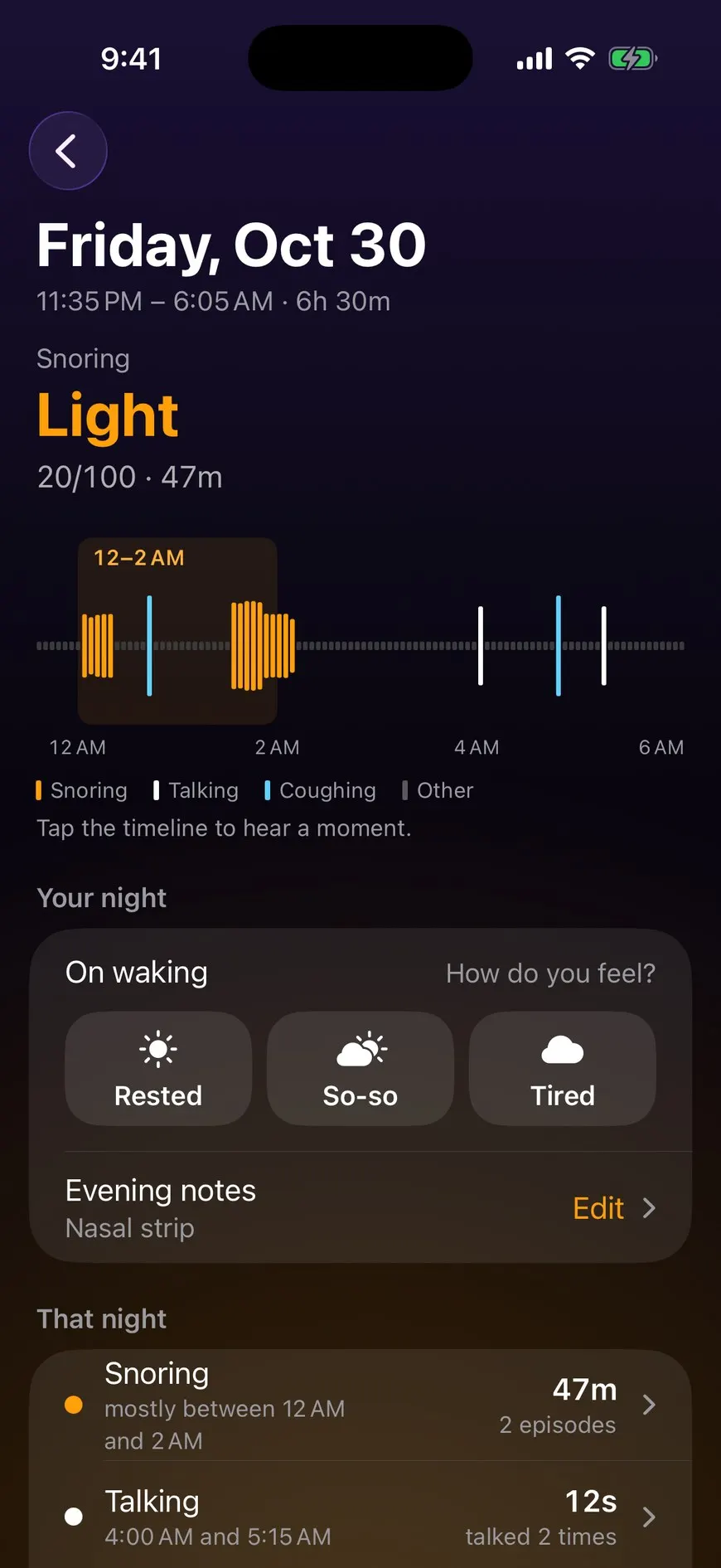
With Sleepeek, the morning screen gives you these answers at a glance: the night’s snoring level (from “Quiet night” to “Very loud”), a score out of 100 that reads as the share of the night spent snoring, your snoring minutes, and a timeline where each bout of snoring shows up at its time. Tap the timeline to listen. In the evening, you can note anything out of the ordinary (a drink, a cold): when you listen back to a night, you know what came before it.
If you snore
For snoring with no other signs, France’s national health insurance advises starting with lifestyle: sleep on your side rather than your back, avoid alcohol in the hours before bed, lose weight if you’re overweight, stop smoking, treat a blocked nose (ameli.fr, in French). If the snoring continues despite these efforts, seeing a doctor is recommended.
Keep recording while you try a change: by comparing your nights before and after, you can see whether it makes a difference for you.
When to see a doctor
France’s national health insurance advises seeing a doctor in these situations (ameli.fr, in French):
- episodes of gasping for breath during sleep, or waking up with a start and a feeling of choking;
- sleep that doesn’t refresh you: you wake up tired and struggle to stay awake during the day;
- falling asleep during the day, in front of the TV, in a meeting or in the car;
- headaches, memory or concentration problems, or irritability along with the snoring;
- snoring that doesn’t go away despite your efforts, or that causes tension with the person who shares your room.
Pauses in breathing noticed by the people around you are also a sign to mention (ameli.fr, in French). Talk to your doctor: if they suspect sleep apnea, they can order a medical sleep recording.
Frequently asked questions
Is there a test to find out if you snore?
No questionnaire can tell you whether you snore: someone has to hear you, or you have to record yourself. The questionnaire doctors use, the Epworth scale, measures daytime sleepiness, not snoring.
Why don't you snore when you're awake?
Snoring comes from the tissues of the throat vibrating as air goes past. During sleep, the muscles at the back of the throat, the soft palate and the tongue relax and narrow the airway. The fact that people don't snore while awake shows that this relaxation is part of the cause.
Can an app tell me if I have sleep apnea?
No. An app hears sound, nothing else. Sleep apnea is diagnosed with a medical sleep recording that measures breathing and blood oxygen; a sound recording can only help you describe your nights to your doctor.
Record yourself tonight: tomorrow morning you'll know if you snored, for how long and at what times.
Sources
- Assurance Maladie (ameli.fr), « Comprendre le ronflement et ses causes », July 1, 2026 (in French), accessed November 4, 2026.
- Assurance Maladie (ameli.fr), « Ronflement de l'adulte et de l'enfant : que faire ? », July 1, 2026 (in French), accessed November 4, 2026.
- Assurance Maladie (ameli.fr), « Symptômes, diagnostic et évolution de l'apnée du sommeil », August 7, 2026 (in French), accessed November 4, 2026.
- MSD Manual Consumer Version, “Snoring”, last updated July 2026, accessed November 4, 2026.
Written by The Sleepeek team. How we write and check our guides.
Read next
- How to record yourself sleeping: a step-by-step guideA sleep recording app and a phone plugged in by the bed are all you need. The settings, the mistakes to avoid and what you'll hear in the morning.
- App that records sounds at night: how it worksAn app that records sounds at night only keeps the sounds louder than your quiet room. How it sorts them, sensitivity, and the sounds that fool it.
- What causes snoring, and how to find your own causeYou snore when your throat relaxes and the air makes it vibrate. The common causes, the ones you can change, and how to spot yours from your nights.